
Carrying Your Own Wood
Reflections on work, purpose, and the meaning of a good life.
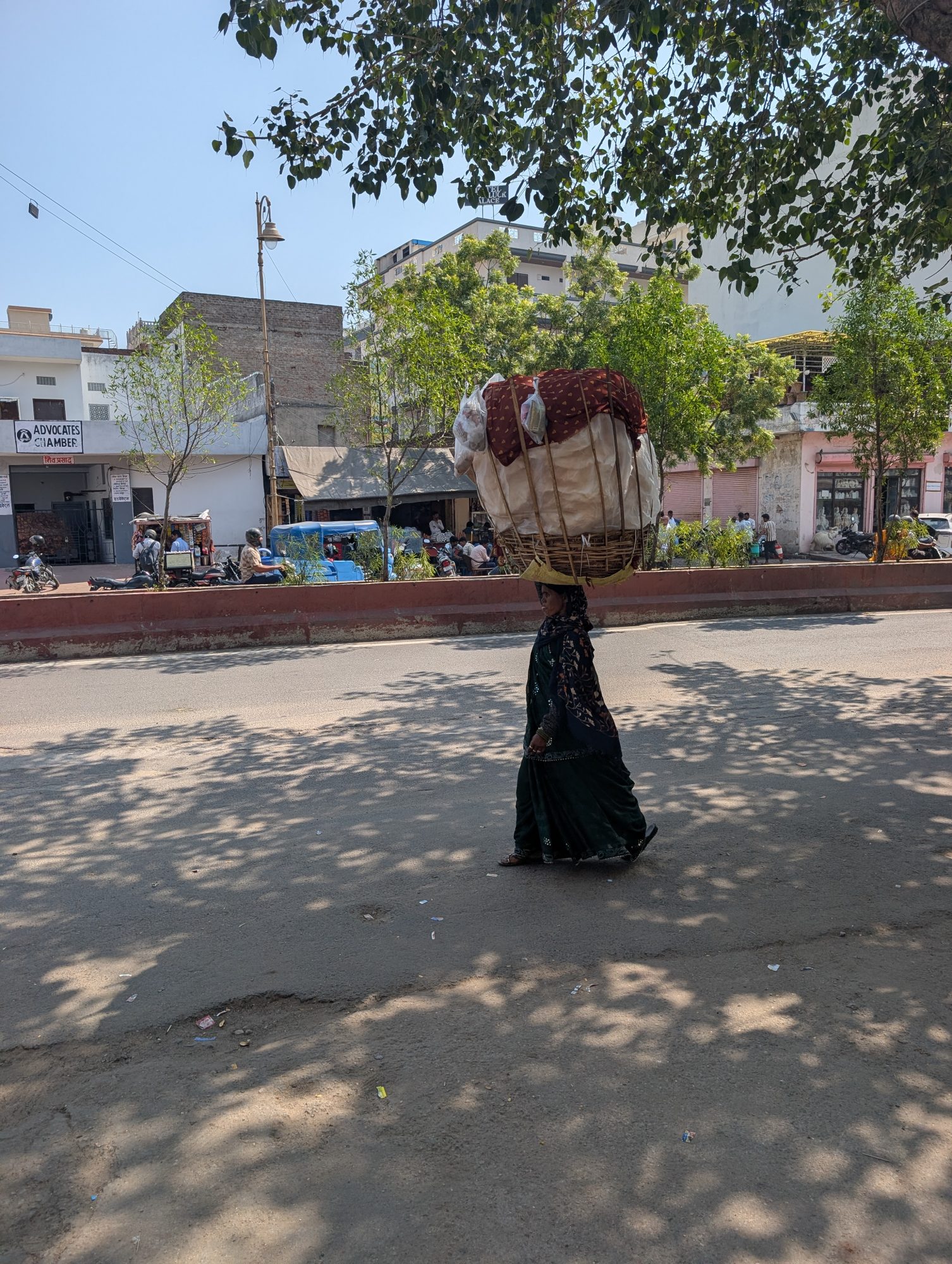
Over the years, as I've traveled through different parts of the world, there's a scene I've encountered countless times. A woman walking along a dusty road, balancing an enormous bundle of firewood on her head. Sometimes it's a stack of grass or grain. Other times, a heavy container of water. Often she's walking considerable distances, making her way back to a small village or a modest home.
I've seen this in countries throughout Asia and elsewhere, and every time, I find myself thinking about how difficult that life must be.
The physical effort. The repetition. The seemingly endless demands of simply getting through another day.
And I suppose, like many Western travelers, I've always viewed these scenes through the lens of my own experience. I see hardship. I see a life without many of the conveniences I've come to take for granted. I see someone working incredibly hard just to meet the most basic necessities of life.
But recently, while traveling through India, I began looking at these scenes a little differently.
And it occurred to me that perhaps I've been overlooking something important.
These women are carrying their own wood.
It's a simple observation, but the more I've thought about it, the more profound it seems.
Every bundle of firewood collected has a purpose. Every container of water carried home serves an immediate need. Every trip contributes something tangible to the lives of the people depending on that work.
There's a direct connection between effort and outcome.
The work is difficult, certainly. Perhaps far more difficult than anything most of us in the Western world will ever experience. And I wouldn't presume to know whether the women doing it find satisfaction in their labor or would happily exchange it for an easier life.
But I can't help wondering whether there's something meaningful about that direct connection between the work we do and the lives we live.
Because in the Western world, so many of us spend our days carrying someone else's wood.
We wake up early, climb into our cars, and sit in traffic for 45 minutes on the way to work. We clock in, sit behind a desk, attend meetings, answer emails, and spend eight or ten hours contributing to the goals of an organization.
Perhaps we're improving efficiency. Increasing quarterly revenue. Finding ways to marginally improve the returns for shareholders we'll never meet.
Then we climb back into our cars, spend another 45 minutes in traffic, and finally arrive home, exhausted.
And we do it again tomorrow.
We've become remarkably good at convincing ourselves that this is what a successful life looks like.
We measure success through salaries, promotions, job titles, and the things we can afford to purchase. We celebrate productivity, economic growth, and corporate profitability as though these are inherently meaningful accomplishments for the individuals producing them.
But whose success are we really measuring?
A company can have its most profitable year in history while the people responsible for that success feel increasingly disconnected from their own lives. An employee can spend decades climbing the corporate ladder, earning more money and accumulating more possessions, only to reach the top and discover that the ladder was leaning against someone else's house.
It's an uncomfortable thought.
We like to believe that our modern economic system has liberated us from the burdens of subsistence living. And in many important ways, it has. We no longer need to collect firewood to cook dinner or walk miles to fetch water. We've developed technologies and institutions that have dramatically improved our quality of life.
But liberation from physical labor hasn't necessarily meant liberation from obligation.
In many cases, we've simply exchanged one form of labor for another.
Instead of spending our days collecting the resources necessary to sustain our own lives, we sell our time to organizations whose goals may have little connection to our personal values. We surrender much of our independence in exchange for a paycheck, then use that paycheck to purchase the necessities and conveniences we no longer have the time or energy to provide for ourselves.
And the more expensive our lifestyles become, the more dependent we become on the very system that consumes our time.
We work longer to afford bigger homes, newer cars, and more conveniences. We purchase things intended to make our lives easier, only to find ourselves working harder to pay for them.
At some point, the distinction between working to live and living to work becomes difficult to recognize.
And perhaps the most troubling part is how rarely we stop to question the arrangement.
We've normalized the idea that five days of our week belong primarily to someone else. That the best hours of our days should be devoted to an employer. That our personal interests, relationships, and ambitions must fit into whatever time and energy remain.
We even have a name for the brief periods when we're permitted to reclaim our own lives.
We call it time off.
Think about that for a moment.
We've constructed a society in which our own time has become something we must request permission to enjoy.
Of course, not everyone experiences work this way. Many people find deep purpose in their careers. Teachers, doctors, craftspeople, entrepreneurs, and countless others derive genuine satisfaction from contributing to something larger than themselves. And meaningful work doesn't have to be performed independently to be valuable.
But there's an important difference between contributing to a shared purpose and spending your life advancing goals that have little meaning to you.
The distinction isn't simply whether you work for yourself or someone else.
It's whether the work you're doing belongs to the life you actually want to live.
And that's what brings me back to the woman carrying firewood.
Her life may be physically exhausting. She may have fewer choices than I do, and she may welcome every opportunity to make that work easier. There's nothing inherently noble about hardship, and certainly nothing romantic about poverty.
But the image has become a reminder of something I think we've lost sight of.
The value of work isn't measured solely by how much money it produces. It's also measured by how directly it connects us to the things that matter.
When you plant a garden, build something with your hands, prepare a meal for your family, or pursue a project simply because you believe in it, the relationship between your effort and its purpose becomes unmistakable.
You're not working to improve a quarterly earnings report.
You're working to improve your own life.
And perhaps that's why so many people who appear successful by conventional standards eventually find themselves searching for something else. They leave corporate careers to start small businesses. They move somewhere less expensive so they can work fewer hours. They take up hobbies that produce little financial reward but enormous personal satisfaction.
They're not necessarily rejecting work.
They're searching for work that feels like their own.
They're trying to reclaim ownership of their time, their energy, and their purpose.
They're trying to carry their own wood.
And maybe that's the lesson I've been slowly coming to understand through my travels.
A meaningful life isn't necessarily the easiest life. Nor is it the one with the largest income, the most impressive title, or the greatest number of modern conveniences.
It's a life in which our daily efforts are connected to the things we genuinely value.
A life where we're not simply exchanging our most precious resource—our limited time on this earth—for the opportunity to participate in someone else's ambitions.
A life where the things we work toward are things we've consciously chosen for ourselves.
Travel has a way of challenging the assumptions we carry about the world. Sometimes it takes seeing a life radically different from our own to recognize something missing in the one we've built.
I still see hardship when I watch a woman walking down a dusty road with an enormous bundle of firewood balanced on her head.
But these days, I see something else as well.
I see a reminder that all of us carry burdens through life. Some are physical. Others are financial, psychological, or emotional. Some are necessary, and others we've accepted without ever questioning why.
Perhaps we can't eliminate those burdens entirely.
But we can be more deliberate about which ones we choose to carry.
And ultimately, I think that's where a deeper sense of meaning begins.
Not in finding a way to avoid the work of living, but in making sure the work we're doing is connected to a life that's truly our own.
Because at the end of the day, if we're going to spend our lives carrying wood, shouldn't it be our own?